.png)
How a Simple Trunnion Setup Can Completely Transform a VMC
- May 19
- 3 min read

Sometimes the most effective machining solutions are not overly complicated. They are built around the right combination of rigidity, access, repeatability, and flexibility.
That is exactly what this setup delivers.
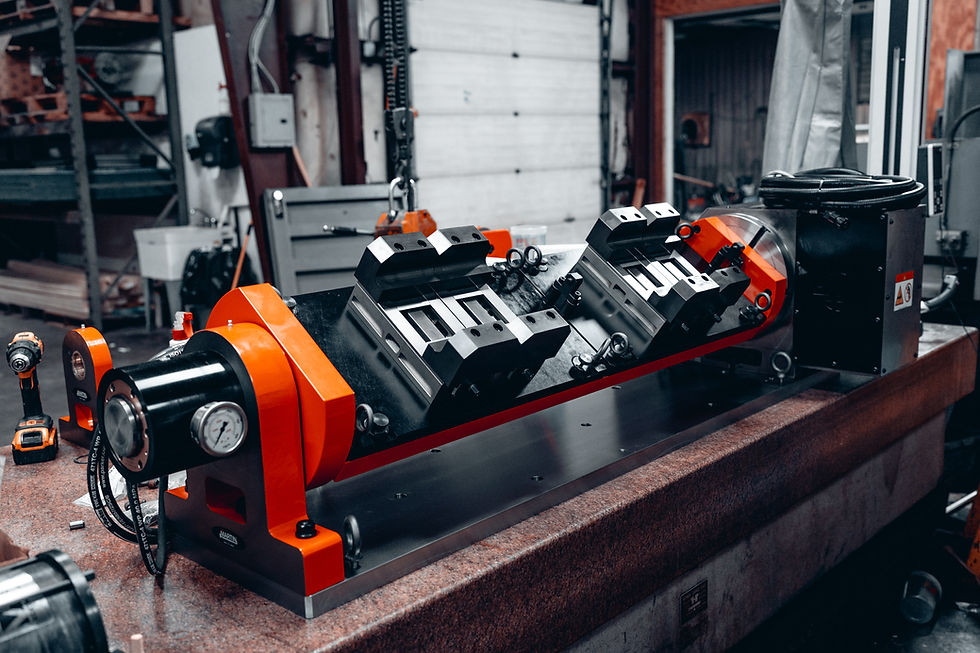
This Stallion Trunnion package is being paired with SCHUNK KSC3 vises, GFD mini zero-point bases, and our TS1200-IB braking system to turn a standard vertical machining center into a much more capable 4th-axis production platform.
For a machine shop looking to get more out of an existing VMC, this is the kind of setup that can make a major difference.
More Access in Every Setup
One of the biggest advantages of a trunnion table is the ability to machine multiple sides of a part without constantly removing, flipping, and re-indicating the workpiece.
With this setup, the customer can access all six sides of a part between the two vises. That means fewer manual operations, less handling, and better consistency from part to part.
Instead of machining one side, stopping the machine, moving the part, and trying to re-establish location, the rotary axis allows the operator to index the work into position. This improves both efficiency and accuracy because the part stays controlled inside the same workholding system.
For many shops, that alone can be a major productivity gain.
SCHUNK KSC3 Vises for Strong, Repeatable Clamping
The SCHUNK KSC3 vises are a strong fit for this type of application because they provide accurate, compact, and repeatable clamping in a production-friendly package.
On a trunnion, vise selection matters. The workholding needs to be rigid enough for aggressive machining, compact enough to maintain clearance, and repeatable enough to support fast changeovers.
The KSC3 vises help make this setup practical for a wide range of parts. They give the customer a clean, flexible way to hold work while taking advantage of the rotary table’s indexing capability.


GFD Mini Zero-Point Bases Add Flexibility
The GFD mini zero-point bases are another important piece of the system.
These bases allow the vises to be oriented in either direction, giving the customer more flexibility when building setups around different part shapes, machining strategies, or clearance requirements.
That flexibility is valuable in a real machine shop environment. Most shops are not running the same perfect part all day, every day. They need setups that can adapt. Zero-point workholding gives them a faster way to change, reconfigure, and repeat jobs without starting from scratch every time.
The result is a trunnion package that is not locked into one single use case. It becomes a flexible platform for repeat work, short runs, and changing production needs.
The TS1200-IB Keeps the Setup Rigid

Access and flexibility are only useful if the setup stays rigid under cutting forces.
That is where the TS1200-IB braking system comes in.
When machining off-center, cutting aggressively, or running heavier parts and fixtures, the rotary table’s standard brake may not always provide enough holding power on its own. Any movement in the rotary axis can affect surface finish, tool life, part accuracy, and overall confidence in the process.
The TS1200-IB adds serious braking support to the outboard side of the trunnion. It is designed to help keep the setup locked in position during heavy cutting, giving the customer a more rigid and stable 4th-axis platform.
This is especially important when the trunnion is being used as a true production tool, not just as a light-duty indexing accessory.
Turning a VMC Into a More Capable Production Machine
The value of this setup is not just the trunnion, the vises, the zero-point bases, or the brake by themselves.
The value comes from how the complete system works together.
The Stallion Trunnion provides multi-side access. The SCHUNK KSC3 vises provide strong and repeatable clamping. The GFD mini zero-point bases provide flexible orientation and faster setup changes. The TS1200-IB braking system adds the rigidity needed for heavier machining.
Together, they give the customer a much more capable VMC setup without requiring a completely new machine platform.
For shops trying to increase spindle utilization, reduce handling, improve repeatability, and make better use of the equipment they already own, this is exactly the type of solution that can move the needle.
A simple setup, done correctly, can completely transform what a VMC is capable of.


Comments