.png)
From First Op to Finish: A Fully Integrated 3-Operation Workholding System
- Jan 8
- 2 min read

Reducing setups is one of the fastest ways to improve throughput, accuracy, and consistency. This fixture was designed with exactly that goal in mind—combining first-operation efficiency with precise multi-axis finishing in a single, integrated system.
First Operation: Four-Part Bison Chuck Plate
The first operation is handled on a dedicated fixture plate designed specifically for Bison chucks. This plate allows four parts to be run simultaneously, making it an efficient and repeatable solution for first-op machining.
By running four parts at once, the system:
Maximizes spindle utilization during the first operation
Ensures consistent part location before finishing
Reduces handling and setup time between operations
This first-op plate establishes a reliable starting point for each part before they move into the trunnion-based finishing operations.


Finishing Operations: Trunnion-Based Precision
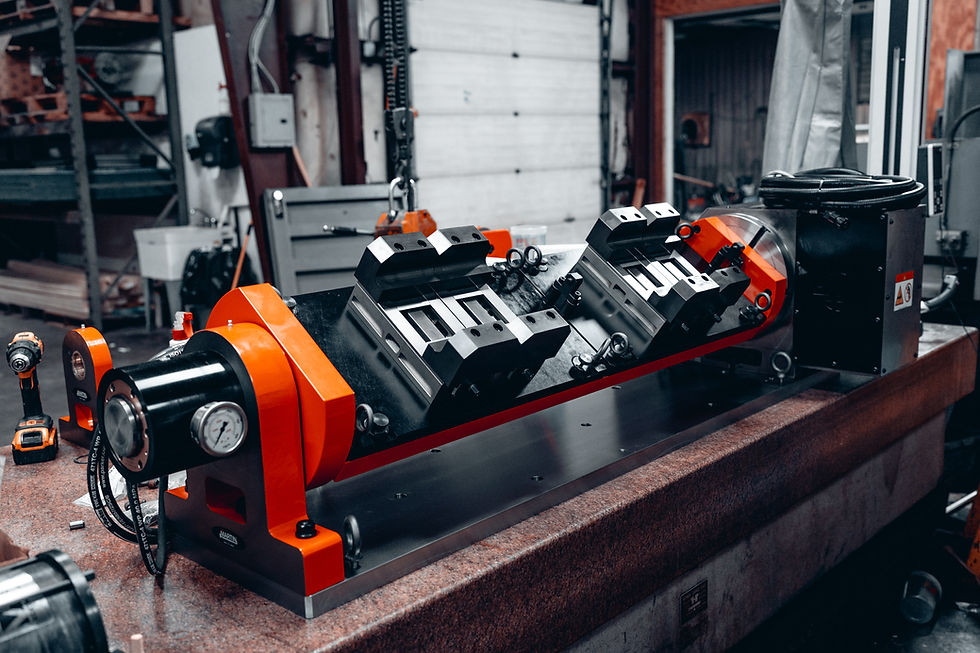
Once first-op machining is complete, parts transition to the trunnion system on the left. This setup is built around a Lyndex-Nikken rotary table, paired with a Stallion 9-23 Trunnion Table, providing the rigidity and accuracy required for finishing multiple faces in fewer setups.
This trunnion configuration enables:
Full access to remaining part features in two additional operations
Accurate indexing and positioning for tight-tolerance features
Improved surface finish by maintaining part datum consistency
Reduced cumulative error compared to multiple standalone fixtures
The combination of the rotary table and trunnion allows complex geometries to be completed efficiently without sacrificing precision.


Stallion Lock Quick-Change Integration
To tie the system together, Stallion Lock quick-change components are used throughout the fixture. This allows for rapid changeover between operations while maintaining repeatability and alignment.

Benefits of the quick-change approach include:
Faster transitions between first-op and finishing operations
Repeatable location without re-indicating or probing
Scalable flexibility for future part revisions or new jobs
Reduced machine downtime during setup changes
Designed as a Complete Process, Not Just a Fixture
What makes this system effective isn’t just the individual components—it’s the way they work together as a complete machining process. First-op efficiency, multi-axis finishing capability, and quick-change flexibility are all integrated into a single solution.
This approach:
Reduces total setups
Improves part consistency from start to finish
Increases spindle utilization
Simplifies operator workflow on the shop floor
For shops running high-mix or growing production volumes, systems like this bridge the gap between flexibility and repeatable production.


Comments