.png)
Case Study: How Global Products and Development Runs Lights-Out on a VMC
- Apr 7
- 3 min read
At Global Products and Development in Spokane, Washington, the goal is simple: get parts through the machine efficiently and consistently.
But like a lot of shops, the challenge isn’t just cutting the part. It’s everything around it. Setups, handling, and making sure the process holds from one run to the next.
From Job Shop to Production
Global Products and Development didn’t start where they are today.
What began as custom work, from early-stage product ideas sketched on napkins to full engineering-grade drawings, gradually evolved into a shop focused on consistent, high-precision production.
Today, much of their work is in the medical field, where accuracy and consistency are critical. That shift brought new demands, not just on the machines, but on the process itself.
The Challenge: More Than Just Machining
As production increased, the limitations weren’t in the cutting. They were in the workflow.
Multiple setups, repeated part handling, and time spent re-positioning and re-probing all added time, variability, and opportunity for error.
“We had four different positions we were trying to hit to make one part," says co-owner Tony Robinett.
The question wasn’t how to cut faster. It was how to simplify everything around the cut.
The Approach: Use the Machine Differently
Instead of adding more machines, the focus shifted to getting more out of the ones they already had.
“We couldn’t upgrade into a bigger machine. We had to utilize what we had. And I think that’s where a lot of shops are.”
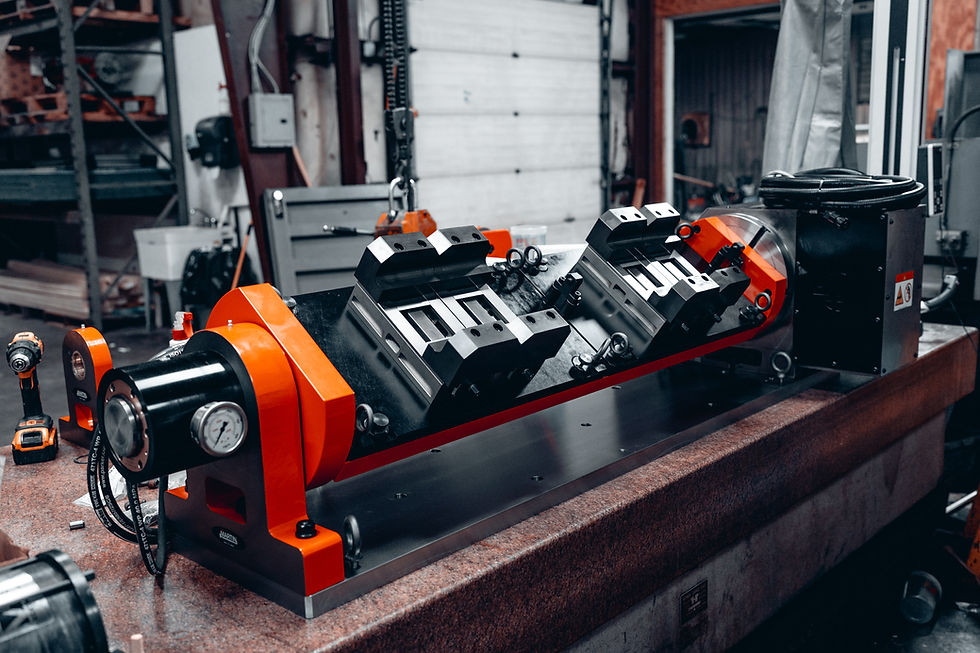
Working with Martin Trunnion Tables, they implemented a 4-axis solution built around Hexagon trunnions and custom fixturing.
The goal wasn’t complexity. It was control. Fixtures were designed around the part, positions were consolidated into fewer operations, and parts stayed in place instead of being moved.
“We reduced it down to a two-operation setup. All that handling is gone.”
Where the Gains Came From
The improvements didn’t come from a single change. They came from how the system worked together.
Fewer setups meant operations could be consolidated. Reduced handling meant parts no longer needed to be moved between fixtures or re-indicated between steps. Because parts stayed in position, consistency improved naturally.
“All the consistency is still there because it never left the fixture.”
Better use of machine time followed. Instead of stopping to reposition parts, the machine continues cutting.
Lights-Out Production
The result is a process that runs without constant intervention.
They are running Hexagon trunnions lights out for up to 10 hours at a time.
In practice, that looks like an operator loading parts at the start of the day, the machine running for over seven hours, and parts being unloaded at the end of the cycle. The process continues with minimal time spent inside the machine.
“I’m only in the machine for about 20 minutes out of the day. It ran for 16 hours,” says Tony.
On larger setups, they are approaching nearly continuous operation.
Solving the “What If” Problems
One of the biggest advantages shows up when parts change.
Without a flexible system, even a small design change like adding an angled feature would require new fixtures, additional setups, and more handling.
Instead, the current setup allows them to adapt without rebuilding the process.
“It would have been more handling and more time outside of the machine.”
The Bottom Line
For Global Products and Development, this wasn’t just a tooling upgrade. It was a shift in how the process works.
“I’ll just put it frank. We wouldn’t have this work if we weren’t machining them this way.”
Without the ability to consolidate setups, maintain consistency, and run extended cycles, they would have needed more machines and more overhead just to keep up.
Instead, they are getting more out of what they already have.
What This Means for Other Shops
This case isn’t unique.
A lot of shops are in the same position. Limited machine capacity, increasing part complexity, and pressure to improve throughput.
The solution isn’t always faster tools or new equipment. Sometimes it’s stepping back and rethinking the process.
When the process is right, the machine runs differently.
Want to See It in Action?
Watch the full case study video to hear directly from the team at Global Products and Development and see how their setup works in practice.


Comments